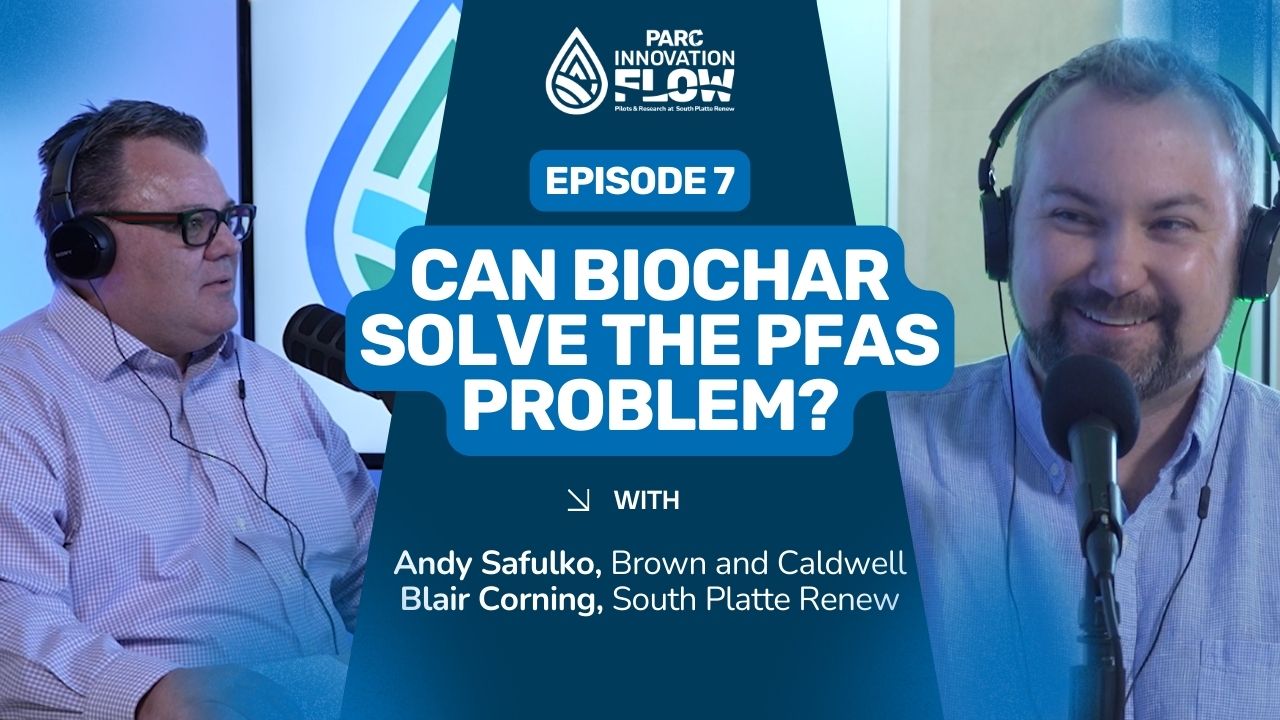


How can we begin to break down the PFAS cycle in the wastewater treatment process? Andy Safulko at Brown and Caldwell says: Biochar! In this episode, Andy and host Blair Corning unpack the growing challenges that these “forever chemicals” pose to land application and what innovative alternatives might be on the horizon. What is the potential of transforming biosolids into biochar as a PFAS treatment? Can we bench test foam fractionation as a PFAS removal technique? This episode explores cutting-edge research that may result in PFAS destruction in biosolids.


How do we execute ideas for pilot projects at PARC? Here, we learn from Brianna Miller, Engineer II at South Platte Renew, who responded to an infrastructure-related challenge with a question: Can we concentrate biosolids in the wastewater treatment process without polymer? By adjusting polymer usage, Bri sought to reduce chemical costs and improve plant efficiency. This is a story of persistence, trial, error, and the data that is now moving this pilot project on to its next phase.


What’s going on at the Pilot and Research Center (PARC) at South Platte Renew (SPR), and what does it take to be a good innovator? This episode features Anna Schroeder, Engineering and PARC Manager at SPR, sharing what’s new and exciting about the PARC program, from groundbreaking pilot projects to the rewards she’s experienced through the process. She and host, Blair Corning, discuss how treating water holistically invites the kind of collaboration and creativity needed to build sustainable solutions. Learn how PARC brings long-term vision to life through detailed, real-world pilot design.


What is the “money value of time” in wastewater master planning, and how is it fueling innovation at South Platte Renew?
In this episode, we talk to Deena Davidson, Municipal Operations Manager at Tetra Tech Water, who describes building flexibility into South Platte Renew’s latest Master Plan. The model allows utilities to intentionally delay critical spending decisions in order to ensure the most current, proven, and cost-effective technology. She and host, Blair Corning, also get into the groundbreaking PdNA pilot happening on-site at South Platte Renew.


In this episode, recorded live from WEFTEC 2025, Jamie Lefkowitz and Mahesh Lunani explore how data science and artificial intelligence (AI) are fundamentally changing the future of the water industry. First, we tackle the urgent challenge of PFAS with Jamie Lefkowitz, Innovation Development Leader at Brown and Caldwell. Jamie shares details on a pioneering research project that uses machine learning algorithms to identify the unique “chemical fingerprint” of PFAS sources. Then Mahesh Lunani, Founder & CEO of Aquasight, introduces Ava, an AI-powered water assistant built to turn utility data into real-time operational intelligence. What’s in store for this new era of digital utility management?

In this live episode from WEFTEC 2025, we sit down with Per Henrik Nielsen of VCS Denmark, a distinguished leader with 40 years in wastewater innovation. He shares our belief that public utilities have an obligation to drive change where vendors and consultants cannot. Learn how VCS Denmark became an energy-positive utility, the challenges and calculated risks involved in pursuing ambitious projects, and why fostering an organizational culture built on trust and a “willingness to fail” is key to the future of water.

Live from WEFTEC 2025, host Blair Corning interviews Bryan Coday, Principal Technologist at Carollo Engineers, to discuss the cutting-edge of biological phosphorus removal. Bryan explains why the industry is in a “golden age of innovation” and breaks down the complexities of Side Stream Enhanced Biological Phosphorus Removal. Bryan details a joint pilot project with South Platte Renew that converted existing infrastructure into a dedicated fermenter. This pilot offers a path to reducing long-term chemical reliance and creating a circular water economy by recovering phosphorus for beneficial reuse.




Leave a Reply